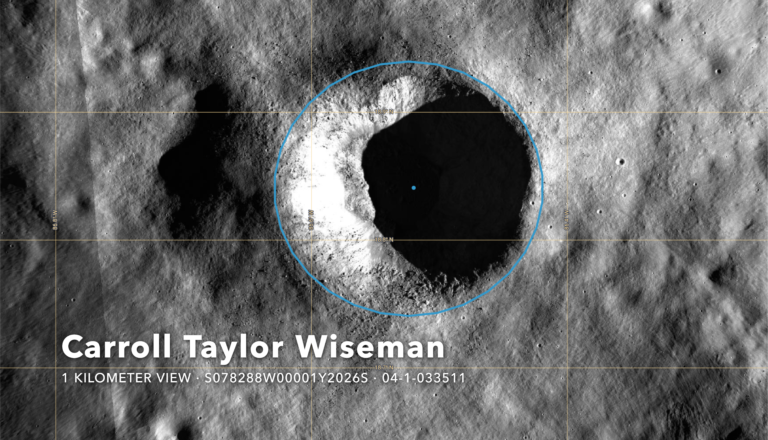
One hundred years after her birth, the legacy of Dr. Nancy Grace Roman continues to shine — this time from the Moon itself. In a fitting tribute, a Lunar crater formerly known as Zagut D has been renamed in her honor, marking the centennial of a scientist whose pioneering work helped launch humanity into a new era of space exploration.
Known to many as the “Mother of Hubble,” Dr. Roman was not only a visionary astronomer but also one of the most influential women in the history of NASA. Born on May 16, 1925, she cultivated an early love for the stars, organizing astronomy clubs and devouring celestial knowledge at an age when few girls were encouraged to look skyward. By the time she earned her Ph.D. in astronomy from the University of Chicago, it was clear that Roman was aiming far beyond Earth’s atmosphere.

In 1959, just a year after NASA was founded, Roman became the agency’s first Chief of Astronomy in the Office of Space Science. She was one of the first female executives at NASA and one of the earliest women to hold such a senior scientific role in the federal government. Her appointment was nothing short of groundbreaking in a field that was, at the time, overwhelmingly male.
During her two-decade tenure at NASA, Roman played a crucial role in planning and developing space-based observatories, long before such projects were considered feasible. She was instrumental in the creation of programs like the Orbiting Solar Observatory and the International Ultraviolet Explorer — missions that redefined how scientists studied the cosmos.
“I knew that I wanted to be an astronomer from the time I was eleven years old.”
Dr. Nancy Grace Roman
But it was her championing of the Hubble Space Telescope that etched her name permanently into the celestial record books. At a time when the very idea of space-based telescopes seemed like science fiction, Roman shepherded the early planning and scientific justification for what would become one of the most important astronomical instruments in history. Without her vision, Hubble might never have made it off the drawing board.
Roman’s work didn’t go unnoticed. Throughout her career, she received numerous accolades, including NASA’s Exceptional Scientific Achievement Medal, the Women in Aerospace Lifetime Achievement Award, and multiple honorary doctorates. She was elected a fellow of the American Association for the Advancement of Science, and later in life, she even had a role model’s cameo – her likeness immortalized in a LEGO minifigure.
Her achievements were all the more remarkable given the era in which she rose to prominence. Roman faced and overcame the entrenched sexism of mid-20th-century academia and government service. She once recalled being discouraged from pursuing science by a high school counselor who told her, “You’re not supposed to be doing that.” Fortunately for the future of astronomy, she didn’t listen.
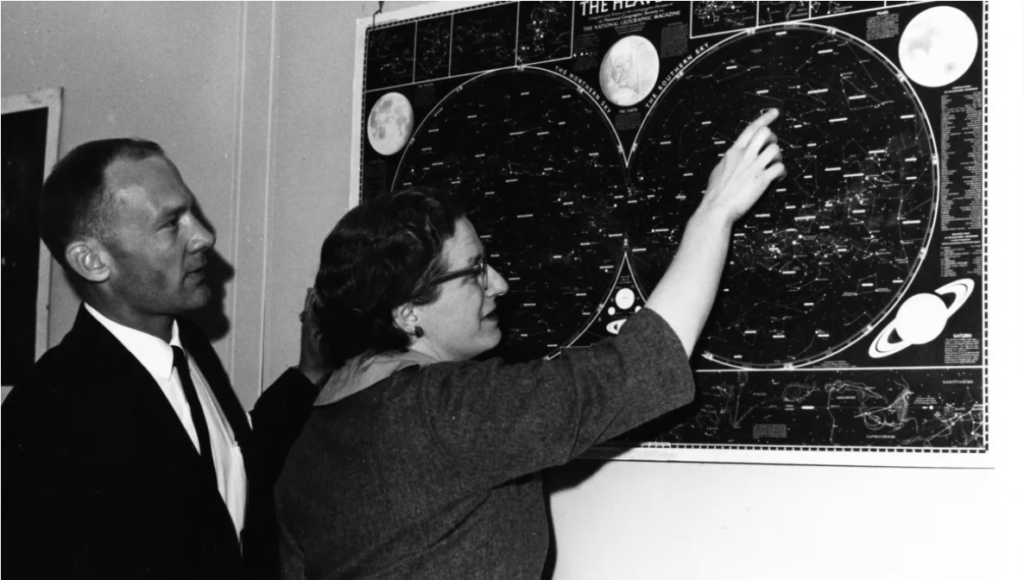
After retiring from NASA in 1979, Roman continued to work as a consultant and advocate for space science, often encouraging young women to pursue careers in STEM fields. She believed passionately in science education, and remained active in the field well into her later years.
(Despite “retiring,” Dr. Roman returned to work in 1981 in the Goddard Space Flight Center’s Astronomical Data Center, and became its director in 1995 before retiring again in 1997 – after which she taught science at a junior high school in Washington, D.C.)
In 2020, NASA paid tribute to her enduring influence by naming the Nancy Grace Roman Space Telescope in her honor. Scheduled for launch on 30 August 2026 at 07:26 AM (EDT; 11:26 UTC) aboard a SpaceX Falcon Heavy rocket from Launch Complex 39A at NASA’s Kennedy Space Center in Florida, the telescope — designed to explore dark energy, exoplanets, and infrared astrophysics — promises to carry her vision forward, gazing farther and deeper into space than ever before.
Now, with a crater on the Moon bearing her name, Dr. Nancy Grace Roman’s legacy is carved into the heavens she spent her life exploring. As the Moon rises tomorrow on what would have been her 100th birthday, it will do so with a new landmark — and a timeless reminder of how one woman’s brilliance helped humanity see the universe more clearly.
Data Set: Crater N.G. Roman
| Eponym: | Nancy Grace Roman, Ph.D. |
| Short Name: | Roman |
| Previous IAU Designation: | Zagut (Zacut) D |
| Location: | Zagut Highlands |
| Latitude (° North-South): | -31.462496° South |
| Longitude (° East-West): | 19.284376° East |
| Diameter (Kilometers): | 14.579 km |
| Crater Catalog ID: | S003687N08545R08407Y2010S |
| Approval Date: | 15 May 2025 |
| Lunar QuickMap URL: | https://bit.ly/459XgZ6 |
Learn more about Dr. Nancy Grace Roman:
- NASA Biography: Dr. Nancy Grace Roman (1925-2018)
- The Nancy Grace Roman Space Telescope (NASA Mission)
- The ‘Mother of Hubble’: Nancy Grace Roman